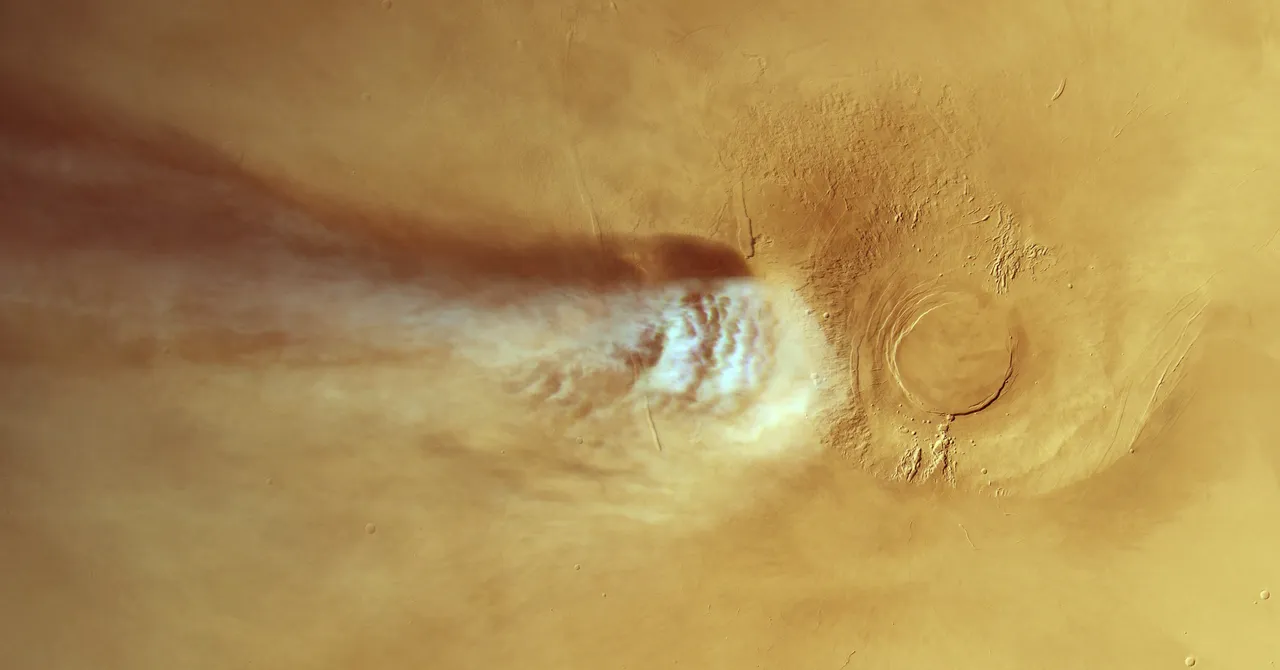

Each morning throughout the Martian spring and summer season, a skinny and intensely lengthy cloud emerges, solely to vanish once more. The wispy formation appears close to the volcano Arsia Mons and progressively elongates till it reaches over 1,000 miles—in regards to the distance from New York to Kansas Metropolis because the crow flies—earlier than dissipating. This cycle then repeats for a number of months.
Because it was first recorded by a probe in 2018, scientists have been unable to discover a believable clarification for the existence of this cloud, also known as the Arsia Mons Elongated Cloud (AMEC). Till now. Lately, researchers successfully modeled the cloud’s formation for the primary time, their outcomes suggesting that it could be pushed by a bodily course of that has by no means been instantly noticed in any planet’s environment.
“We discovered that we would have liked to incorporate some unique physics … physics that, whereas included in textbooks, is handled as theoretical and normally thought to not occur in nature. It definitely hasn’t been seen in motion earlier than,” Jorge Hernández-Bernal, a planetary scientist at Paris’ Sorbonne Université and lead writer of the research, mentioned in a press release. “As soon as we included this physics in our simulations, the AMEC emerged simply as we hoped.”
On Earth, clouds normally type when water vapor creates droplets or ice crystals within the presence of tiny particles, reminiscent of mud or salt. The brand new research, revealed in Nature Geoscience, as a substitute suggests AMEC might be forming via so-called homogeneous nucleation, the place vapor modifications instantly into ice crystals by itself with none assist from particles.
“It’s akin to droplets of condensation showing in the course of a room, fairly than on a window,” Hernández-Bernal defined. “It’s wholly sudden.”
This phenomenon requires excessive circumstances—a pointy temperature drop of 30 levels Celsius inside 10 minutes and excessive relative humidity. The Arsia Mons volcano additionally performs a key position. When wind present hits the 65,000-foot-tall volcano, it creates a strong wave that launches moist air excessive within the environment in a matter of minutes.
Scientists have assumed an analogous phenomenon may happen within the higher atmospheres of different planets, together with Venus and even Earth, however it has never been observed. That’s not too stunning given the acute air humidity required for this phenomenon, which is greater than 100,000 occasions higher than any worth measured on Earth.
Earlier than this modeling, it was not recognized that these humidity ranges existed on Mars both. “We don’t have almost as a lot details about Mars’ atmosphere as we do about Earth’s, so reproducing the AMEC to this diploma is an enormous success,” mentioned Hernández-Bernal, including, “the result’s outstanding.”
This story initially appeared on WIRED Czech Republic and Slovakia and has been translated from Czech.