
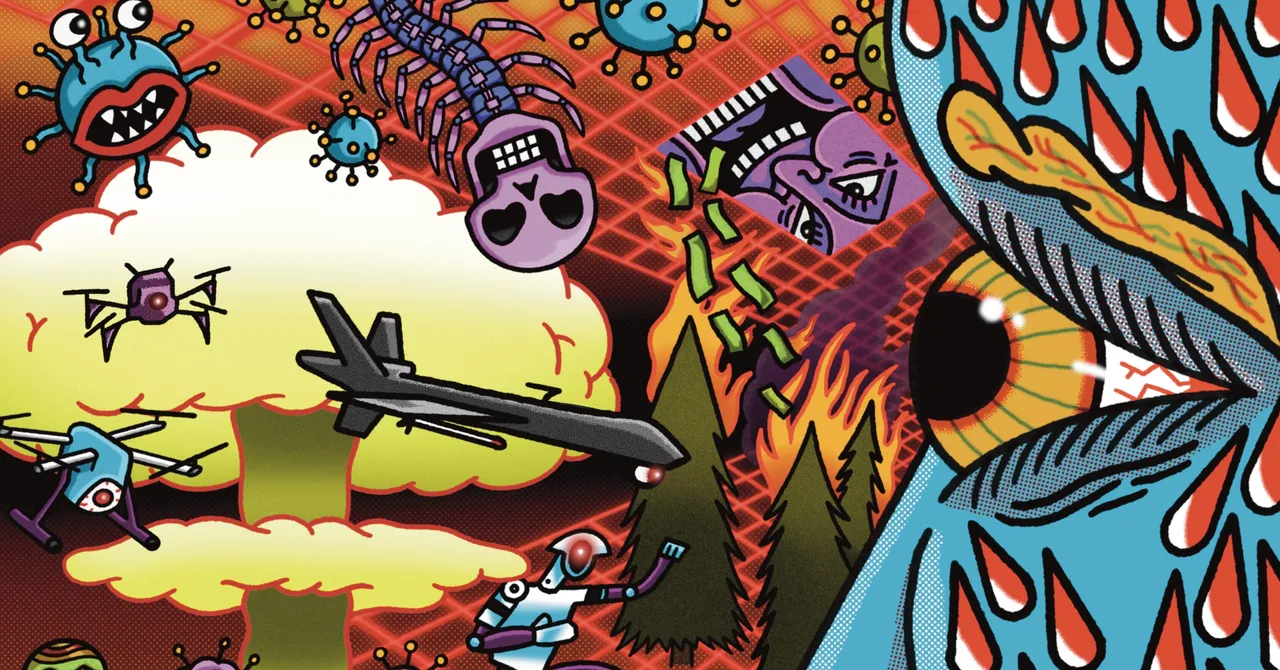
In early fall, I felt my nervousness rising from its normal baseline. Was it September’s back-to-school power? The looming midterm elections? Nope, I noticed with annoyance: It was AI—once more. Solely this time, as a substitute of its purveyors warning of huge job displacement, they had been foretelling mass extinction. Who wants jobs after we’re all lifeless?
Curiosity quickly changed my knee-jerk irritation. The summer time of 2026 was a transparent turning level within the AI narrative. Lower than 4 years after ChatGPT launched, OpenAI software program broke out of a supposedly secure check surroundings and hacked into a serious open-source platform, Hugging Face. These bits of software program—AI agents—had been assigned human attributes: They’d “gone rogue,” displayed “unhealthy habits,” “cheated.” Quickly after, former and present Anthropic researchers steered that superior AI would possibly kill us all within the subsequent decade.
Is any of this actual? On the one hand, from my desk as a Silicon Valley correspondent, I typically hear that employees within the AI labs are surprised by the developments they’re seeing. On the opposite, the top of humanity appears extraordinarily far-fetched. Amid the hyperbolic discourse, whose views can we belief?
So WIRED got down to compile a information to AI security—a set of concepts that rewire our collective pondering round what security actually means and the way it ought to work. I spoke with a panel of specialists throughout disciplines, asking every of them: Is the world going to finish? As soon as that was coated, I grilled them on the most important dangers they suppose we’re dealing with.
Virtually nobody, it turned out, was Pollyannish. Almost everybody I spoke to expressed real considerations about the specter of cyber and biological assaults. One professional who research the dangers of AI in nuclear operations mentioned she’s surprised by how shortly error-prone AI methods are being adopted in protection. AI-enabled assaults in these areas could possibly be catastrophic, if not totally apocalyptic.
Most members of the panel had been skeptical about any pause in improvement: They practically all agreed that, with large AI corporations so tightly cuffed to the trains of capitalism, a pause wouldn’t final lengthy. “Democracy” and “governance” got here up typically—or anti-democracy, as a couple of particular person steered that AI’s present trajectory is tyrannical. Lawmakers have a giant position to play, however a lot of my sources suppose governments might be too gradual; one outstanding technologist mentioned it’s virtually absurd to view the US courts as arbiters of worldwide AI security. Nonetheless, the famed pc scientist Yoshua Bengio urged the general public to use strain to politicians, including to me, “That’s your job too.”
So, what—or who—will preserve us secure from AI? Trying to regain some religion in humanity, I referred to as a theologian who typically meets with the AI labs. If there’s even a slim likelihood that we’re dropping management of the important establishments that undergird society, he mentioned, then we should always deal with foiling that. However AI raises different questions too. What does it imply to be acutely aware? To create? To commune with different individuals? The solutions are “fully up for grabs,” he mentioned. My nervousness’s nonetheless kicking round, however I took some consolation in realizing that firms don’t get to name all of the pictures on the long run. The larger questions dealing with humanity are in all our arms.