
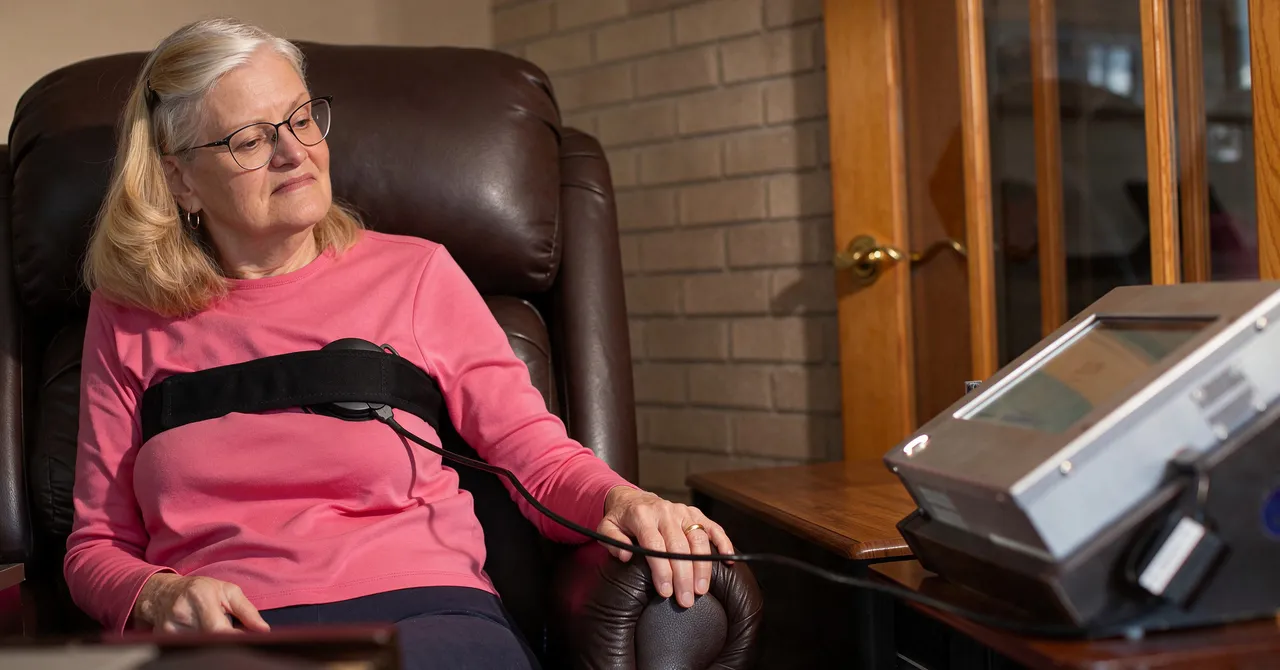

A Michigan lady named Mary has a chip in her brain roughly the scale of a dime. Although she struggles to talk attributable to motor neuron illness, the implant permits her to precise her ideas by way of a synthesized voice on a pc.
Made by brain-computer interface firm Paradromics, the implant is outwardly invisible, however the speech decoding requires a cart filled with electronics. A 12 months from now, nevertheless, that cart will likely be remodeled right into a small field that may sit on her wheelchair, due to expertise from Nvidia. Ultimately, these electronics will likely be so small they’ll slot in a cellphone, says Paradromics CEO and founder Matt Angle.
Right now, Austin-based Paradromics introduced a partnership with the AI chipmaker to make use of Nvidia’s {hardware} and software program to course of its mind knowledge. Nvidia is dealing with a serious management shakeup and federal scrutiny following longtime CEO Jensen Huang’s resignation over an affair with an alleged Chinese spy.
Although Mary has misplaced a lot of using her talking muscle mass, neurons in her mind nonetheless fireplace when she makes an attempt to talk. The Paradromics implant makes use of greater than 400 embedded electrodes to seize these alerts, and a pc makes use of synthetic intelligence to make inferences about what she’s making an attempt to say. The phrases seem on a display, and the pc speaks the phrases for her.
That decoding course of takes an unimaginable quantity of computing energy. The cart of electronics must be plugged into {an electrical} outlet, and Mary should be inside vary of the cart with the intention to use her brain-computer interface.
“We’re producing an enormous quantity of knowledge that has a whole lot of worth, however we have to translate that neural knowledge into purposes with the intention to make this a very efficient platform,” Angle says. It’s why he calls brain-computer interfaces the last word case for edge computing, a distributed computing mannequin that processes and shops knowledge in bodily units near the place it’s generated slightly than sending it to a distant cloud or knowledge middle.
“We would like to have the ability to do it by way of more and more smaller and lower-power units, and the folks main in that space are Nvidia,” he says.
Making brain-computer interfaces sensible and transportable for sufferers is a serious problem for the sphere. Whereas these setups have develop into much more streamlined since their early days in educational labs, they nonetheless require a lot of exterior electronics. Shrinking them down and lowering their energy necessities would permit sufferers to be extra cellular with these units, utilizing them wherever they go.