
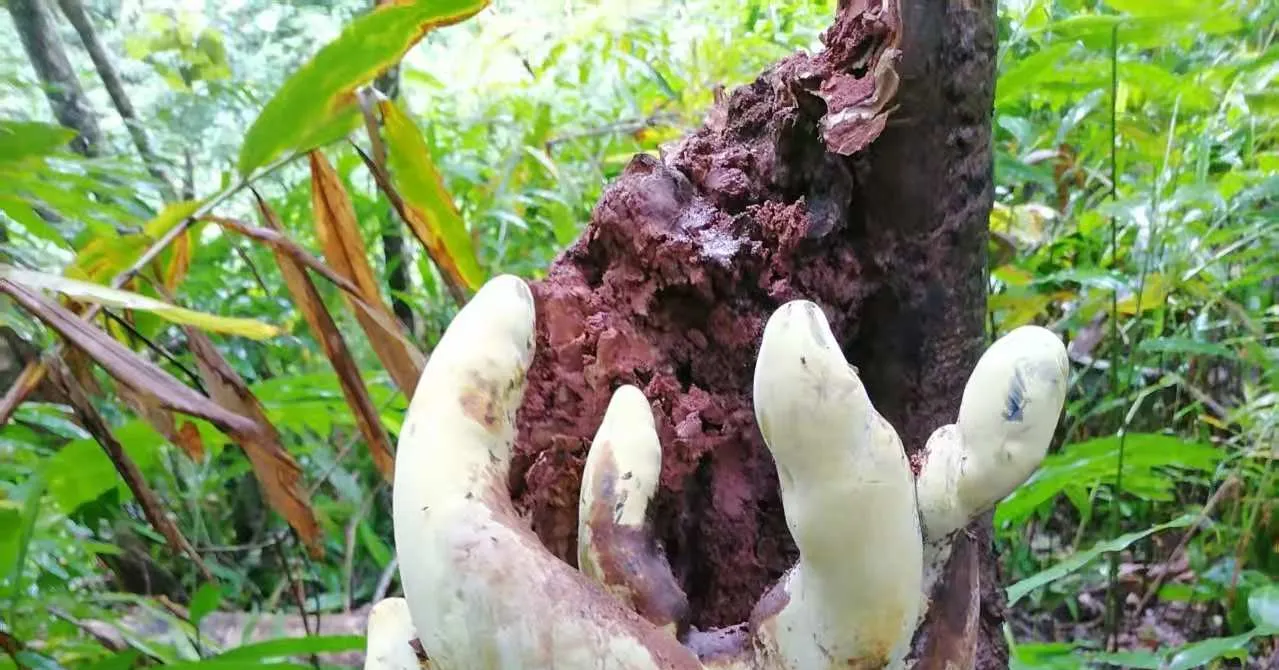

Typically new species evade detection as a result of they’re tiny and thus simple to overlook—not this big fungus. Formed like a hand reaching out of the bottom, this new species of fungus was found deep within the forest in China’s Yunnan Province. A analysis crew from the Kunming Institute of Botany, a part of the Chinese language Academy of Sciences, reported it as a brand new species they named Dianjunus rex.
The title comes from the area’s historic Dian Kingdom and the Chinese language pronunciation of the phrase “fungus.” D. rex is a sort of Ascomycete, which is the biggest phylum of fungi with over 64,000 recognized species, and amongst them, this new fungus produces the biggest masses of mushroom recorded. In contrast to what we sometimes consider as a “mushroom,” Ascomycetes don’t type caps and stems however produce structures known as fruiting our bodies, which launch spores to breed. And rising as much as 20 inches and weighting practically 5 kilos, D. rex’s are large.
Inside the Ascomycetes, the large fungus constitutes a wholly new organic household (the broader classification of genus and species), which means that it has no shut kinfolk—not less than that we all know of. Whereas 6,000 fungal species have been documented in Yunnan, mycologists consider the province recognized for its biological diversity may simply harbor 100,000
“The invention illustrates how a lot fungus biodiversity stays to be found in East Asian forests,” Indunil C. Senanayake, an affiliate professor on the Kunming Institute of Botany and the lead creator of the paper, mentioned in a press release.
Senanayake and his analysis crew performed surveys within the Nanban tropical rainforest, the place they got here throughout giant, whitish fruiting our bodies rising within the soil close to the roots of dying timber. They documented and picked up fungi rising in all kinds of shapes like cylinders, spindles, and cupped palms. The fruiting our bodies appeared to develop finger-like branches upon maturity. They discovered that the above-ground parts are coated with white, powdery fibers that flip darkish yellow because the fungi mature whereas the parts buried within the soil are black and clean.