
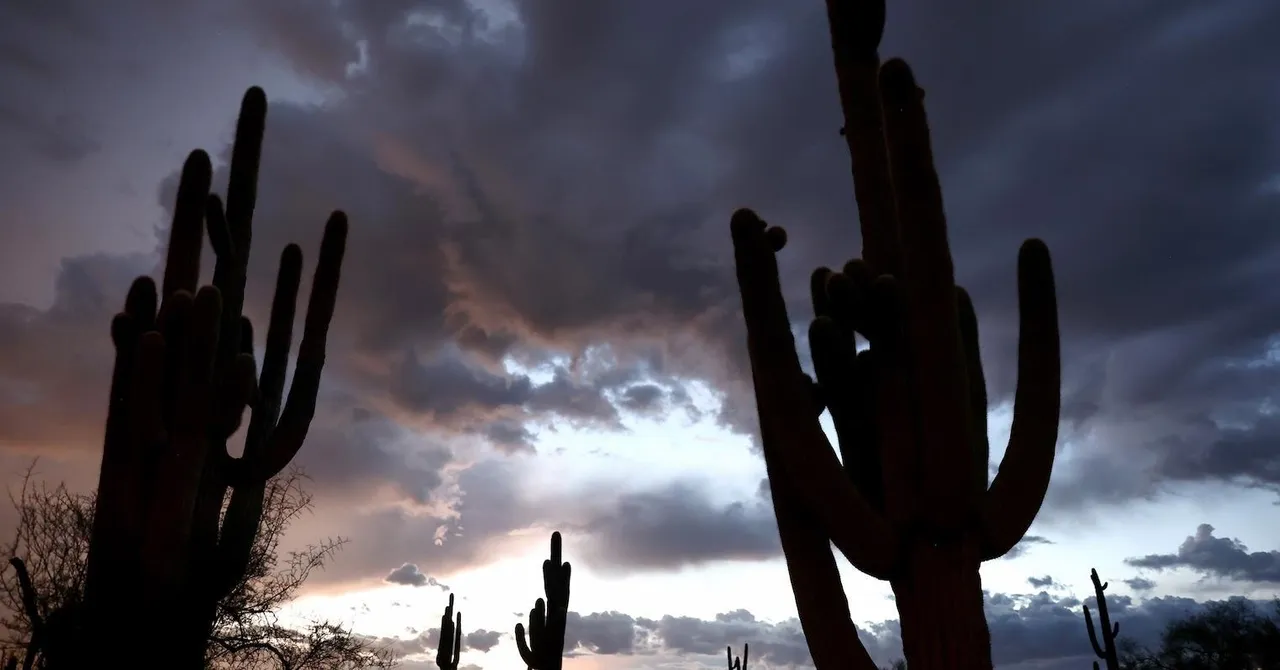

Put one other manner: Cactus species might be affected by sublethal results of drought—the shortage of water might not kill them instantly however nonetheless intervene with their replica. And with out procreation, populations shrink. Within the Sonoran Desert, for instance, the enduring, towering saguaro is reproducing less frequently throughout extended droughts, as a result of they’re not at all times flowering.
A part of the issue is that whereas desert ecosystems might look powerful and hardened total, they’re in actual fact fairly fragile. “They don’t recuperate shortly as soon as they’re disturbed, or as soon as they’re degraded, simply because there’s so little water and such greater temperatures,” stated Marcos Robles, the Nature Conservancy’s lead scientist in Arizona, who wasn’t concerned within the analysis. “It takes a number of a long time to recuperate, and in some instances, they don’t recuperate.”
Now drought is compounding with different stressors, like habitat loss and poaching, to drive cactus species to the brink. On the other finish of the spectrum, too much water from rising seas has led to the local extinction of the Key Largo tree cactus in Florida. Larger nighttime temperatures are an issue, too, since that’s when saguaro and different cacti respire to keep away from water loss. “If the nighttime temperatures are very excessive, they’ll’t do it,” stated Rod Haenni, president of the nonprofit Cactus and Succulent Society of America, who wasn’t concerned within the paper. “Then when you water on high of that, the vegetation simply rot.”
Nonetheless, some cactus species might persist by selecting up and leaving. Effectively, not particular person vegetation, however populations may creep into areas with climates that extra intently match what the species tailored to all these millennia in the past. An identical factor is occurring within the Arctic, truly, the place some plants are marching farther north in “search” of more and more agreeable climate and extra water.
Ultimately, the aim of this kind of analysis is to higher inform the place conservation professionals may focus their efforts. They will’t cease droughts, after all, however they’ll evacuate sufficient cacti to determine populations in botanical gardens, the place they are often cared for because the local weather grows extra unrecognizable to even the hardiest desert vegetation. Species may even be reintroduced to the wild in some instances, as long as drought and excessive temperatures don’t stay a menace to a inhabitants.
Governments, too, want to guard the lands the place cacti are threatened, Haenni stated. This new analysis, he added, may make that occur. “Hopefully, it’ll wake individuals up,” Haenni stated. “However the issue is that a number of the governments concerned are detached to this. There are lots of people within the nations who will not be detached, however they’re not operating the governments.”
This story initially appeared on Grist and is a part of the Climate Desk collaboration.