
In 2022, a strange rock was discovered within the Sahara Desert, and now a brand new evaluation reveals that it’s much more invaluable to science than it first appeared. This fragment, weighing about two kilos, got here from Mars’ crust. It was seemingly ejected by an affect, flying by means of house till it eventually reached Earth. The rock is likely one of the oldest identified samples from our neighboring planet, estimated to be at the very least 4.1 billion years previous. At the moment, Earth was a younger planet with intense geological activity, seemingly with oceans however no animals, vegetation, or every other complicated life.
The situation isn’t what makes this discovering stunning. The Sahara has lengthy been a sort of pure archive of the historical past of Earth and the solar system. Amongst its sands, scientists have discovered 40-million-year-old fossils and different meteorites. In 2019, for instance, a 4.5-billion-year-old fragment was recovered that, based on current analysis, could have come from an historic, now-vanished protoplanet, probably as massive because the moon.
The meteorite, named Teghaza 001, might need remained simply one other entry within the assortment of Martian fragments discovered on Earth. Though these rocks are terribly helpful for finding out Mars’ composition and geological historical past, they usually present restricted details about the environmental situations of its distant previous. Nonetheless, a sequence of research revealed within the journals Science and Science Advances revealed that Teghaza 001 isn’t like different samples. Along with being exceptionally previous, it has preserved chemical traces of the interplay between supplies within the Martian crust and its historic hydrosphere.
“One of many paper’s reviewers known as it a Rosetta Stone for Mars,” Yang Liu of NASA’s Jet Propulsion Laboratory mentioned in a press release.
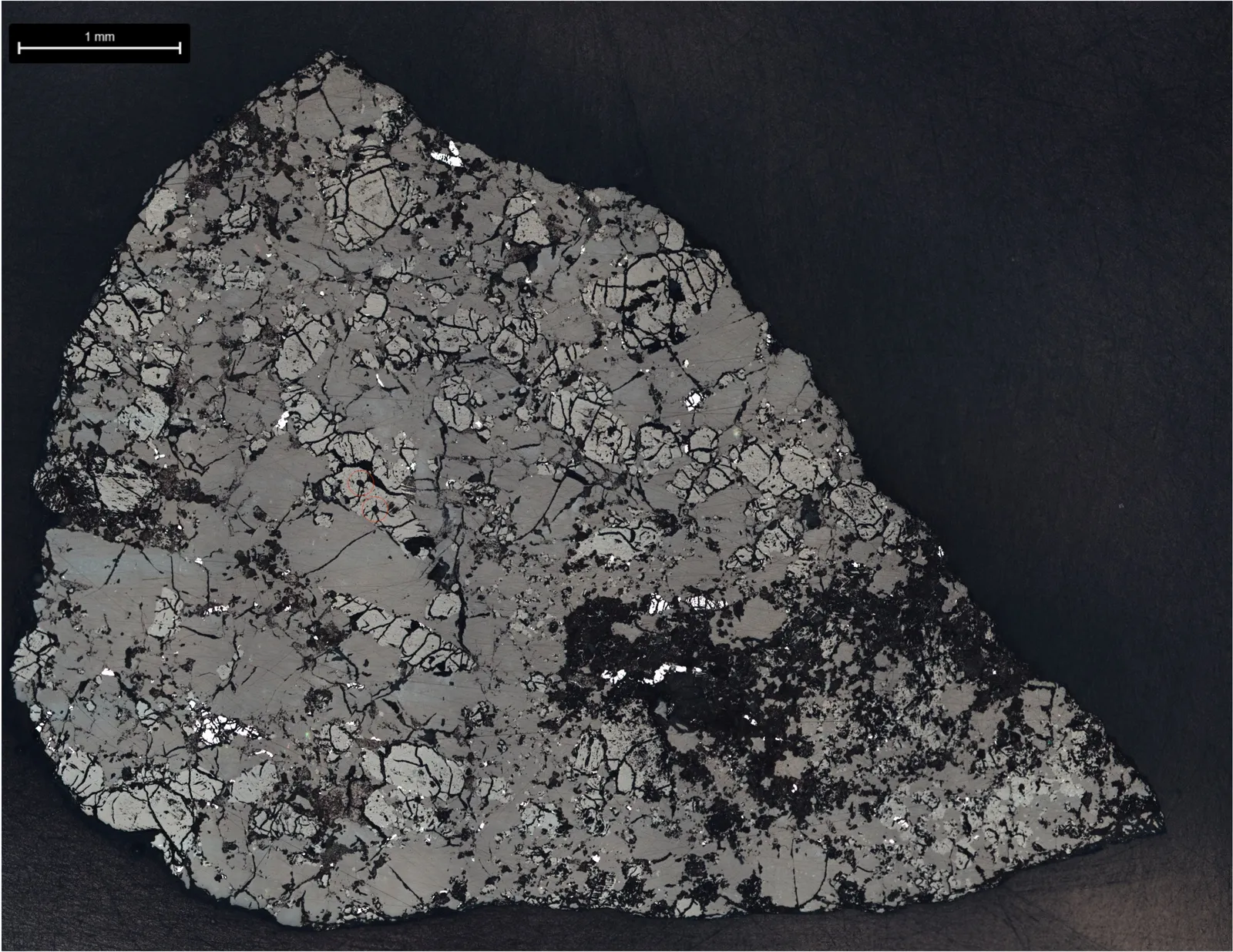
This slice of the meteorite was used to review the traditional minerals and their chemistry.{Photograph}: NASA/JPL-Caltech