
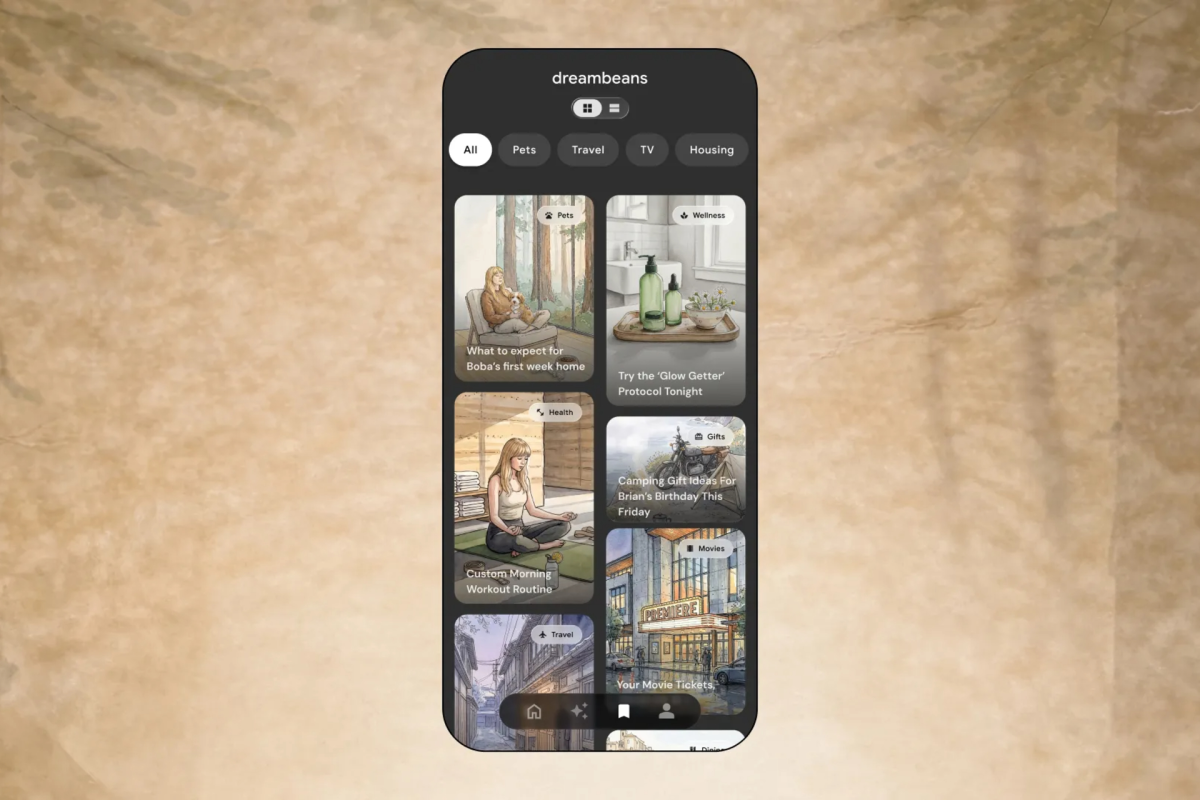

Google has launched its experimental AI app Dreambeans in India, its first market exterior the U.S., as the corporate seems to be to faucet the world’s second-largest web market to convey personalised visible tales drawn from customers’ digital exercise to a broader viewers.
On Monday, Google expanded Dreambeans, out there on Android and iOS, to India with help for 13 native languages, together with Hindi, Punjabi, Tamil, Telugu, and Bengali, alongside English. The launch comes lower than two months after Google made the app available to all eligible U.S. users aged 18 and older.
Introduced in June, Google’s Dreambeans makes use of info from linked Google providers, together with Calendar, Gemini, Gmail, Images, Search, and YouTube, to proactively generate personalised, illustrated tales about customers’ pursuits and on a regular basis lives, with out requiring them to enter a immediate. The app initially featured static, AI-generated illustrations, however Google lately added a characteristic that makes use of its Veo video-generation mannequin to even animate pictures in choose tales.
Google stated it selected India as Dreambeans’ first worldwide market due to robust curiosity from Indian customers in search of entry to the app and the widespread use of its providers within the nation. India stood out for its excessive overlap of customers throughout Gemini, Gmail, and Google Images, Google product supervisor Gozde Oznur stated throughout a press briefing.
Dreambeans has recorded practically 55,000 downloads within the U.S. since its June debut, based on estimates from market intelligence agency Sensor Tower shared with TechCrunch. About 63% of these downloads got here in September, when Google opened the app to all eligible U.S. customers aged 18 and older. Nevertheless, downloads dropped 84% month over month to about 5,500 in October.
Within the first 30 days after Google opened Dreambeans to all eligible U.S. customers, the app recorded an estimated 29,000 downloads, in contrast with 7.4 million for Meta’s Muse, 2.8 million for ChatGPT, 362,000 for Grok Bot, and 155,000 for Claude throughout their respective first 30 days after launch, Sensor Tower estimates present. Nevertheless, in contrast to these general-purpose AI apps, Dreambeans focuses on producing personalised tales as an alternative of responding to a broad vary of person queries.
Despite the fact that Dreambeans helps many broadly spoken Indian languages, customers can choose just one language at a time for his or her generated tales. The app can draw on info throughout Google providers in a number of languages, nevertheless it can not at the moment generate tales that blend languages, Oznur stated through the briefing.
That would restrict Dreambeans’ enchantment in India, the place many individuals repeatedly change between languages, together with Hindi and English, typically mixing the 2 in what is usually often known as Hinglish.
Dreambeans’ dependence on info from customers’ Google accounts additionally raises questions on privateness and knowledge entry. The app makes use of Google’s Personal Intelligence technology to attract on linked providers and personalize its AI-generated tales. These providers can include delicate private info that some customers could not need to share with an AI app simply to obtain personalised content material.
Customers can select which Google providers to connect with Dreambeans and disconnect them at any time, Oznur stated. They will additionally delete their Dreambeans knowledge from throughout the app. Furthermore, Oznur asserted that info deleted from the underlying linked providers can be faraway from Dreambeans’ personalization system.
Customers, Oznur stated, can inform Dreambeans to keep away from sure topics, together with business-related info, and the app will attempt to regulate its tales accordingly. She added that Dreambeans is offered solely to private Gmail account holders, not enterprise customers, and that generated tales are seen solely to the account holder.
Dreambeans’ proactive strategy additionally carries the danger of surfacing recollections that customers could discover upsetting. Oznur acknowledged that Dreambeans may generate tales involving individuals who have died, for example. She stated customers can inform the app to cease exhibiting sure topics, evaluating the characteristic to controls in Google Images that allow customers restrict which recollections seem.
Oznur instructed reporters that Google is exploring methods to make Dreambeans extra actionable, shifting past personalised tales and proposals to assist customers act on the app’s solutions.
If you buy by hyperlinks in our articles, we may earn a small commission. This doesn’t have an effect on our editorial independence.


