
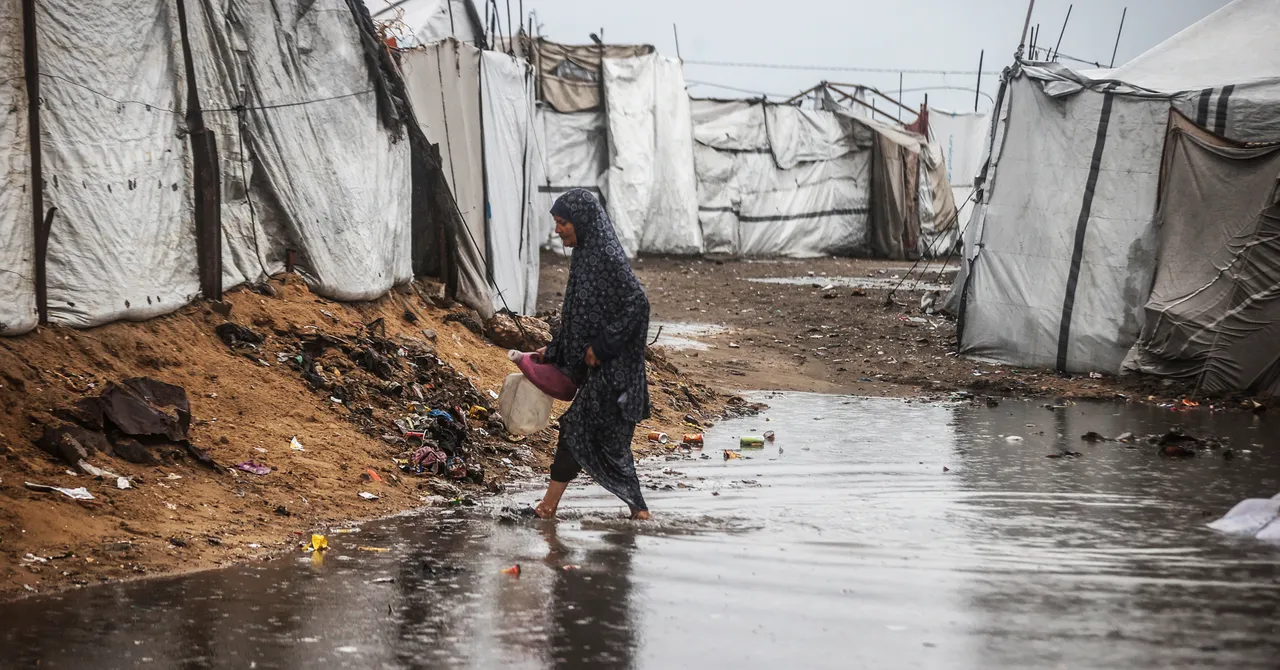

For Hanan Saied, 46, the storm soaked the bedding and clothes she shares together with her seven youngsters. She lives in a shelter in Al Maghazi with mud partitions, cracks, and plastic sheeting overlaying the roof, which WIRED Center East visited.
“The home flooded, and stones and dust fell on us,” Saied says. “The bedding was soaked, and the kids’s garments had been soaked.”
Her youngsters used buckets to maneuver water away whereas her eldest son tried to restore the shelter. Saied spent the evening holding her daughter, Sara, who she says has bronchial asthma, making an attempt to maintain her heat.
Gaza’s Authorities Media Workplace has mentioned at least 70,000 tents sheltering displaced Palestinians had flooded inside 12 hours.
On 8 November, the Israel account on X, run by Israel’s Ministry of Overseas Affairs, posted, “Opposite to widespread perception, Israel doesn’t management the climate.” The put up didn’t explicitly point out Gaza floods.
The flooding comes after widespread destruction of Gaza’s housing. An April assessment by the European Union, United Nations, and World Financial institution discovered that greater than 371,888 housing models had been broken or destroyed and round 1.9 million individuals internally displaced, usually repeatedly.
By 8 November, the United Nations Workplace for the Coordination of Humanitarian Affairs (OCHA) estimated that 1.4 million individuals—65 % of Gaza’s inhabitants—had been residing in tents or shelters. Humanitarian companions had obtained appeals from greater than 26,000 households whose shelters or belongings had been broken.
In Al Maghazi, Jawad describes 5 displacement websites throughout the camp’s western and northern areas. Components sit on low floor the place rainwater accumulates with out an outlet.
His groups used pumps to maneuver water outdoors the displacement websites. However the issues lengthen beneath the streets.
Israeli bombardment has broken sewage manhole covers in Al Maghazi, Jawad says. Different covers have been stolen or deteriorated over time. The ensuing openings enable rainwater to pour into sewage networks unable to accommodate the additional quantity, inflicting wastewater to overflow.
“The sewage networks grow to be unable to accommodate the portions of sewage along with the rainwater that leaks into the manholes as a result of the covers are lacking,” he says.
Substitute covers are unavailable regionally, whereas supplies wanted to manufacture alternate options are scarce and costly. The municipality can’t afford all of the work required. Retaining the water provide working takes precedence.
“I think about spending cash on sustaining wells or sustaining turbines to function water wells the next precedence than allocating a few of that cash to sustaining sewage manhole covers,” Jawad says.