

It’s principally been the topic of Hollywood movies, however someday, an asteroid or comet may collide with Earth and trigger critical injury. We do not have to look all that far again for an instance. In 1908, in an incident now generally known as the “Tunguska Event,” an area rock, possible a number of dozen meters huge, exploded over Siberia. Although scientists weren’t capable of go to the location for one more twenty years, the panorama was nonetheless scarred from the explosion.
Astronomers predict that in mid-April 2029, the asteroid Apophis will fly by Earth. The 450-meter-wide physique will miss us at a distance of solely 19,000 miles. That’s about 12 occasions nearer to us than the moon and far nearer than many satellites. It should even be seen to the bare eye.
Up to now few many years, there’s been huge progress in making these kinds of predictions. As house probes deepen our data of small bodies within the photo voltaic system, astronomers have more and more dependable and detailed knowledge for locating potentially hazardous asteroids. Our skill to answer such a menace, nonetheless, is one other story. That is the lacking and intensely necessary hyperlink—planetary defense technology that would permit us to deflect a harmful object in time.
In a sci-fi flick, such conditions are sometimes solved with a nuclear bomb. However in the true world, blowing up a giant house rock into tiny bits isn’t splendid. As an alternative, it’s higher to change the asteroid’s orbit. All the pieces within the vacuum of house is in movement. Our personal planet travels about 20 miles each second. If the item hurtling in the direction of us might be slowed down and thus attain the assembly level a little bit later, it can merely miss the Earth.
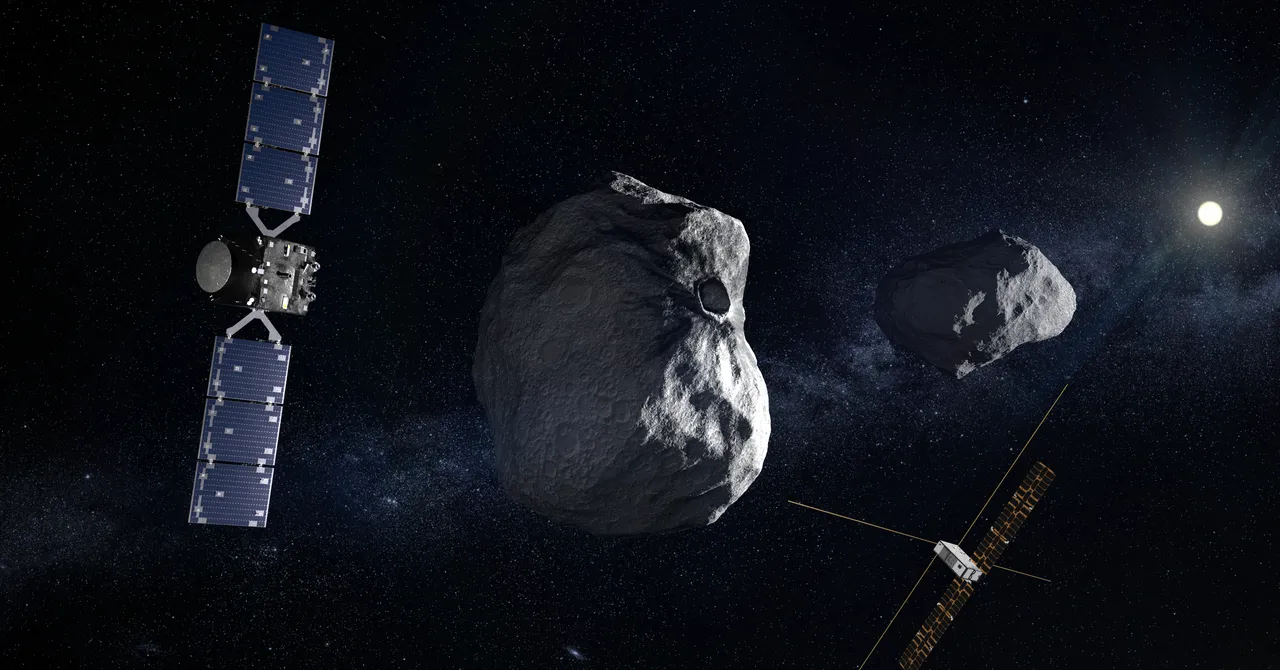
4 years in the past, this was basically what NASA examined on a pair of celestial our bodies generally known as Didymos and Dimorphos. Astronomers on the Kitt Peak Observatory found Didymos, an asteroid measuring 780 meters throughout, 30 years in the past. A couple of years later, Czech astronomer Petr Pravec noticed that this asteroid had a “moonlet” orbiting it about each 12 hours. This smaller body, measuring about 151 meters in diameter, was then named Dimorphos.
The paired objects have been an ideal testing floor for the form of deflection a planetary protection system would contain. Locked in on these targets, NASA launched the Double Asteroid Redirection Check (DART) in late 2021. Almost a yr later, the DART probe crashed into Dimorphos.