
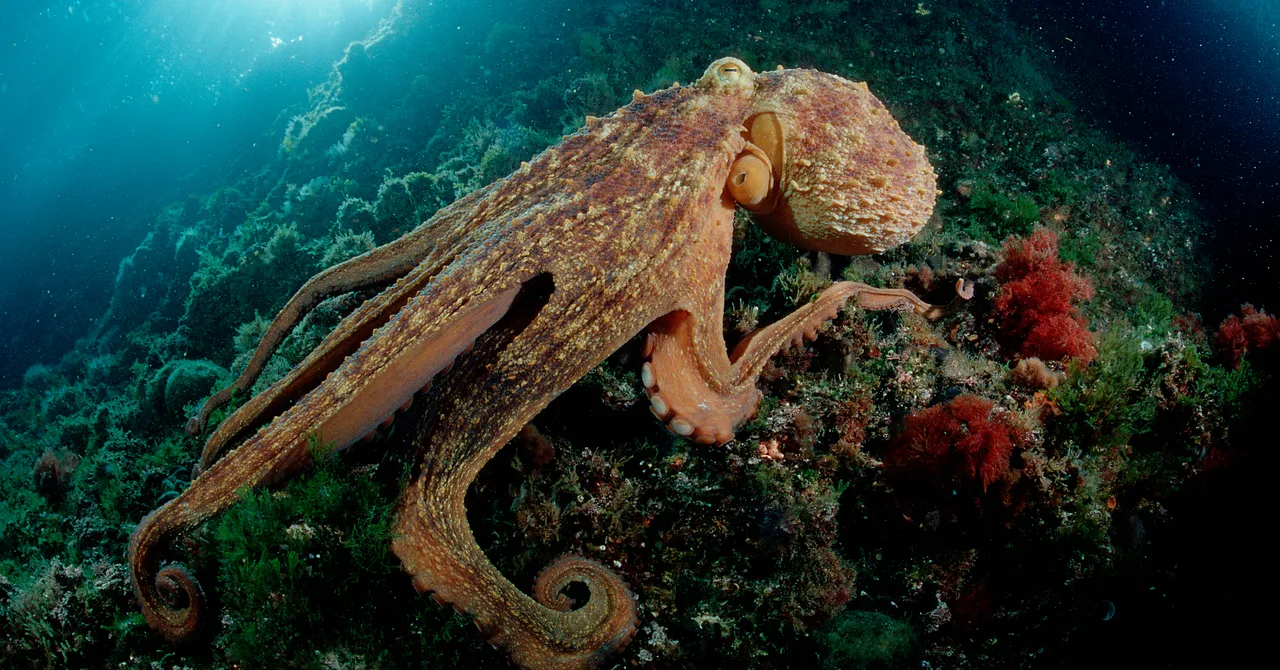

Squeezing your physique into the tiniest potential area is not any straightforward activity, however it may be very helpful, particularly if you happen to’re a soft-bodied creature residing within the fiercely aggressive ocean. Octopuses are the masters of this type of contortion, having the ability to squeeze by way of nearly any opening wider than their beaks. Not solely is it a formidable feat, however scientists have an interest on this capacity as a result of it might support within the design of biologically inspired robots.
In a recent study revealed within the Journal of Experimental Biology, researchers uncovered the method octopuses undergo to squish themselves into small areas. Earlier than this, “there [was] no details about how octopuses squeeze by way of a gap far smaller than the physique diameter,” Wen-Tzu Hsing, first creator of the examine, stated in a press release.
The analysis workforce arrange a tank divided by a clear acrylic panel with a gap in it, permitting the octopus to maneuver by way of the opening to the opposite facet. They categorised the openings as giant or small relying on whether or not the octopuses must squish the stiff cartilage construction that protects their central nervous systems, which the researchers might estimate by measuring the space between their eyes.
What stunned the scientists was the marginally completely different approaches octopuses used when shifting by way of gaps of various sizes. When the hole was on the bigger facet, the method concerned three distinct steps. First, the creatures would discover the opening with their arms. They’d then often insert two arms by way of to the opposite facet earlier than threading their different arms and mantle by way of the opening. Usually, this ultimate step concerned suckering the arms that led the best way to the barrier for elevated leverage.
The three step course of octopuses use to maneuver by way of bigger gaps.Video: Michael Kuba
Nevertheless, when the holes received smaller, the octopuses opted for a four-step course of as an alternative. The method was the identical as much as the second stage—the place a number of arms have been threaded by way of the opening—however the subsequent actions differed barely. For a smaller opening, the octopus would rotate its physique upward and push the bases of the arms that had already handed by way of deeper into the opening to widen the passage. From that place, it twisted and stretched its arms to feed all of them by way of. Then, as soon as all appendages have been on the opposite facet, the octopus slid its head by way of, additionally utilizing its tentacles on the barrier for leverage.
Within the 30 profitable makes an attempt to cross by way of the opening noticed on this experiment, the octopuses by no means used this four-step sequence when offered with the massive gap. Moreover, side-view footage confirmed that over the last step of shifting by way of a small opening, the octopus deforms its mantle to cut back its diameter. The octopuses also had a preference for which arms they used for the assorted steps.
An octopus deforming its mantle to cut back the diameter.Video: Michael Kuba
These experiments have been carried out with juveniles from two species, the widespread octopus and the Maya octopus. The researchers subsequently don’t know whether or not these processes maintain true throughout other octopus species, however past the strictly organic world, the researchers counsel that these findings could possibly be helpful for the design and management of soft robots.
In environments the place the scale of passageways can’t be predicted—akin to amongst particles at catastrophe websites—robots used for search and rescue have to be designed to fit by way of the narrowest passages. Consequently, many current robots undertake a protracted, slender, snake-like form; nevertheless, miniaturization inevitably comes on the expense of sensors and operational capabilities. The analysis workforce hopes to use the insights gained from the octopus on this experiment to the management of soppy robots designed to go looking catastrophe particles or discover troublesome terrain.
This story initially appeared on WIRED Japan and has been translated from Japanese.