

The unique model of this story appeared in Quanta Magazine.
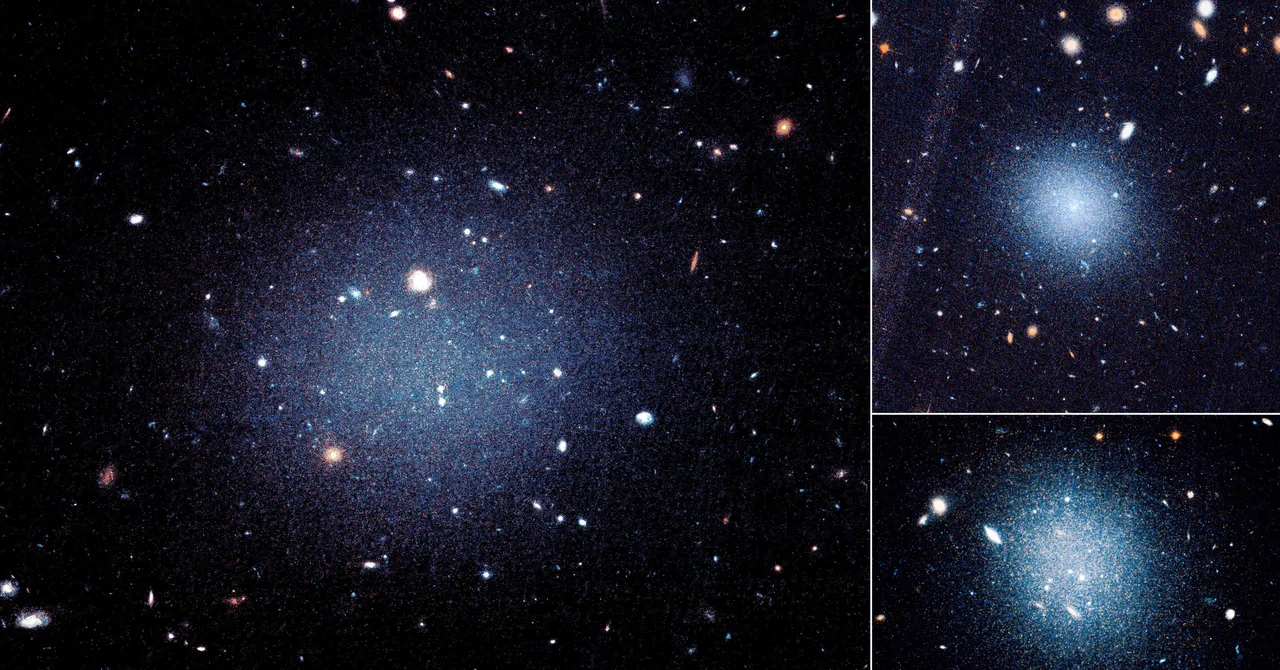
About 65 million light-years from Earth, three galaxies don’t look fairly proper. They aren’t whirlpools bursting with gentle, however pallid objects dimly illuminated by a smattering of stars. “They’ve this ghostly look,” mentioned Michael Keim, an astrophysicist at Yale College. And this isn’t even the weirdest factor about them.
Darkish matter is the invisible glue that retains the biggest constructions within the cosmos collectively. It attracts atypical, seen matter towards it, permitting stars to type and protecting the stelliferous limbs of galaxies from flying off. “Nearly all galaxies are dominated by dark matter,” mentioned Shyam Balaji, a theoretical physicist at King’s Faculty London.
However these three diffuse galaxies, referred to as DF2, DF4, and DF9, have left astronomers surprised. After utilizing a collection of telescopes to estimate their plenty—utilizing the motions of their stars as a proxy—the researchers discovered that each one three have little darkish matter. As a substitute, a pittance of ordinary matter alone will need to have cast their small collection of stars. How may these rule-breaking galaxies have shaped?
A paper printed in June 2026 in The Astrophysical Journal affords a possible answer. As soon as upon a time, two common galaxies collided. Their atypical matter—their fuel and dirt—swirled about and acquired clumped up. However the darkish matter handed proper by and continued on, like a specter passing by a wall. The cosmic pileup left behind three new galaxies, every bereft of darkish matter, every left to battle to type a brand new batch of stars.
It’s a convincing rationalization for a lot of consultants—one which, crucially, might inform us one thing concerning the mystery of dark matter.
Some scientists have prompt that darkish matter, which has but to be instantly detected, might not exist. As a substitute, they suggest {that a} tweak to our understanding of the gravitational drive would possibly clarify numerous options of the universe.
These weird galaxies pour chilly water on that concept. “What that is displaying is that darkish matter is … not only a modification of gravity,” mentioned Keim, who’s an creator of the brand new research. When you segregate atypical matter from darkish matter, you’d anticipate that the dark-matter-lacking galaxies would battle to type stars—and that’s what DF2, DF4, and DF9 present.
That means, as many have suspected for a while, that darkish matter is a physical thing. “The absence of darkish matter is, in a manner, some proof of darkish matter, which is ironic,” Balaji mentioned.