

Then there’s the query of whether or not SMART may worsen the continual scarcity of air visitors controllers. The FAA hopes that the expertise lessens the scarcity by requiring fewer staff; different industries, although, have but to see AI-generated efficiencies truly materialize. Even when the software program doesn’t immediately change people, the effectivity might be used to justify a workforce discount. In Might, the FAA decreased its staffing goal for energetic air visitors controllers from the 2024 objective of 14,633 right down to 12,563, citing “fashionable staffing fashions and scheduling instruments.”
Some are extra optimistic than others. “I feel the SMART program is a vital enchancment,” Schiavo says. “Nobody needs the present aviation atmosphere with midairs, runway incursions, myriad close to misses, delays, groundings, lack of separation, and lengthy taxi or clearance wait instances.”
Michael McCormick, a professor of air visitors administration at Embry-Riddle Aeronautical College, additionally sees benefits to a predictive device. “When you have got the computing functionality to take a look at the whole trajectory of the plane, you may see the place the conflicts are going to be,” he says. “And the overall axiom in air visitors management is that the earlier you recognize a couple of potential battle, the much less effort is required to resolve it.”
That sounds nice, however constructing machines that do a superb job more often than not is one factor; machines that may perform on the degree of reliability required by aviation is one other. At current, researchers are specializing in so-called deterministic neural networks—fashions skilled offline whose weights are frozen earlier than being deployed in the actual world. These can’t hallucinate, however they might harbor different dangerous failure modes. In a 2021 paper, Darren Cofer, a researcher at Collins Aerospace, identified that when such techniques discover themselves in conditions they haven’t encountered earlier than in coaching, they’ll generate “sudden (and doubtlessly harmful) outputs.”
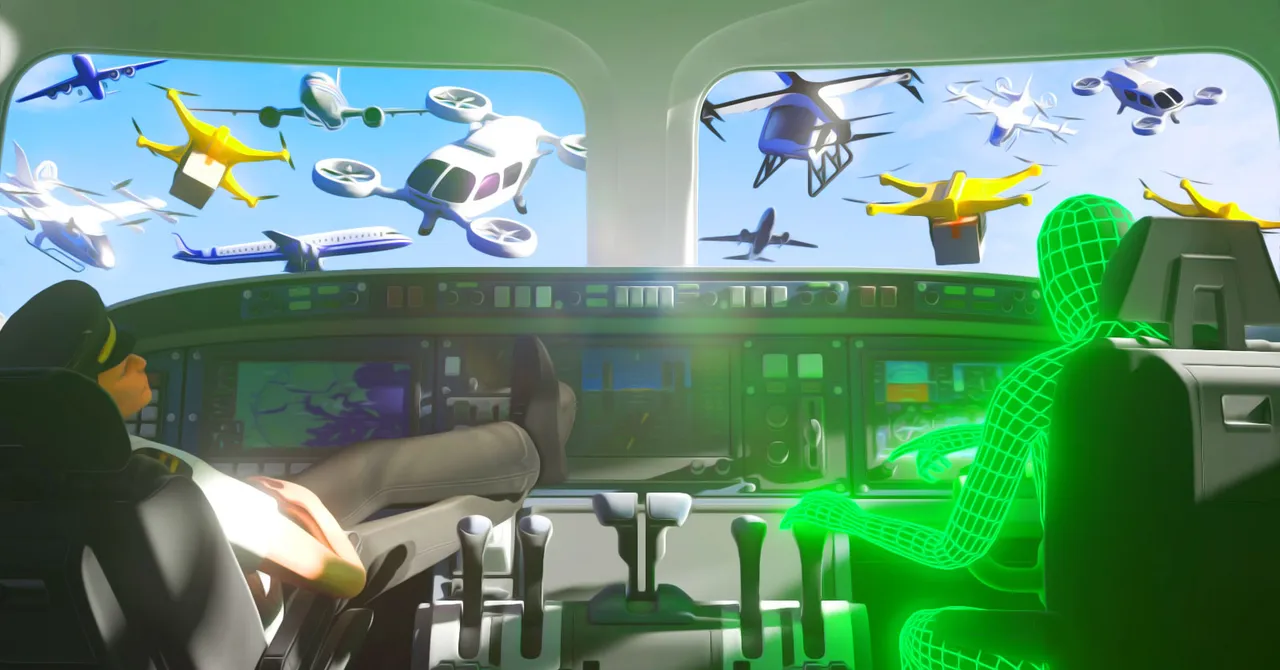
The stakes will probably be even increased when AI software program begins making real-time air visitors management choices, which can begin in airspace dedicated to autonomous plane. In response to McCormick, that’ll almost definitely be choose corridors close to drone hubs and eVTOL vertiports. With swarms of robotic plane zipping forwards and backwards, issues will probably be too furry for human pilots and controllers. “The target is to not use conventional air visitors management,” he says, “as a result of it could overwhelm the nationwide airspace system if it tried to deal with that quantity and complexity of airframes transferring round.”
With two techniques working facet by facet—one with human decisionmakers, the opposite with AI—we’ll have a real-time foundation to check the efficiency of each approaches. Any computer-based system can doubtlessly be hacked; any AI system inventive sufficient to ideate novel options may additionally hallucinate essential particulars. With out a human within the loop, seemingly apparent errors may go unnoticed till it’s too late.
Tell us what you concentrate on this text. Submit a letter to the editor at [email protected].


