

What if a robotic might be squishy? Smooth, versatile robots might be helpful for all kinds of functions, together with synthetic muscular tissues and wearable devices—or actually any utility the place a robotic have to be especially delicate.
That is what has fueled growth of “smooth actuators” that may flex like a bicep and have a fine-tuned sense of contact as within the human hand. Like your stereotypical robotic, smooth actuators convert vitality—akin to electrical energy, warmth, or gentle—into mechanical movement, however they appear nothing just like the metallic and wire constructs that the phrase “robotic” most frequently evokes.
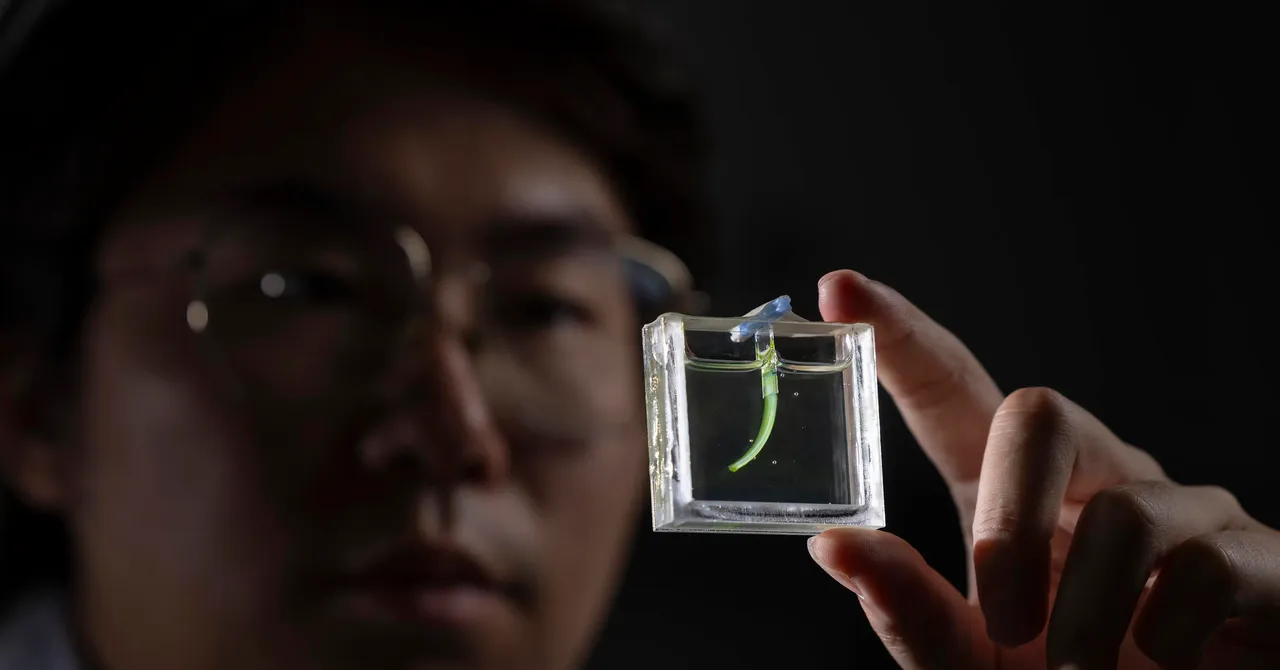
One number of these smooth robots, referred to as bioactuators, makes use of the features of residing cells to generate movement. These organic machines have attracted specific consideration in recent times, and now a analysis crew at Delft College of Expertise within the Netherlands has developed a smooth robotic arm colonized by algae on its floor, and when the microbes photosynthesize, the arm strikes.
“We didn’t begin with a particular utility. Our purpose has all the time been to deliver the analysis of residing supplies to new ranges,” Marie-Eve Aubin-Tam, who led the analysis, defined in a press release. “We needed to discover what turns into attainable when residing cells are built-in into practical supplies.”

Video: Studio Oostrum/TU Delft