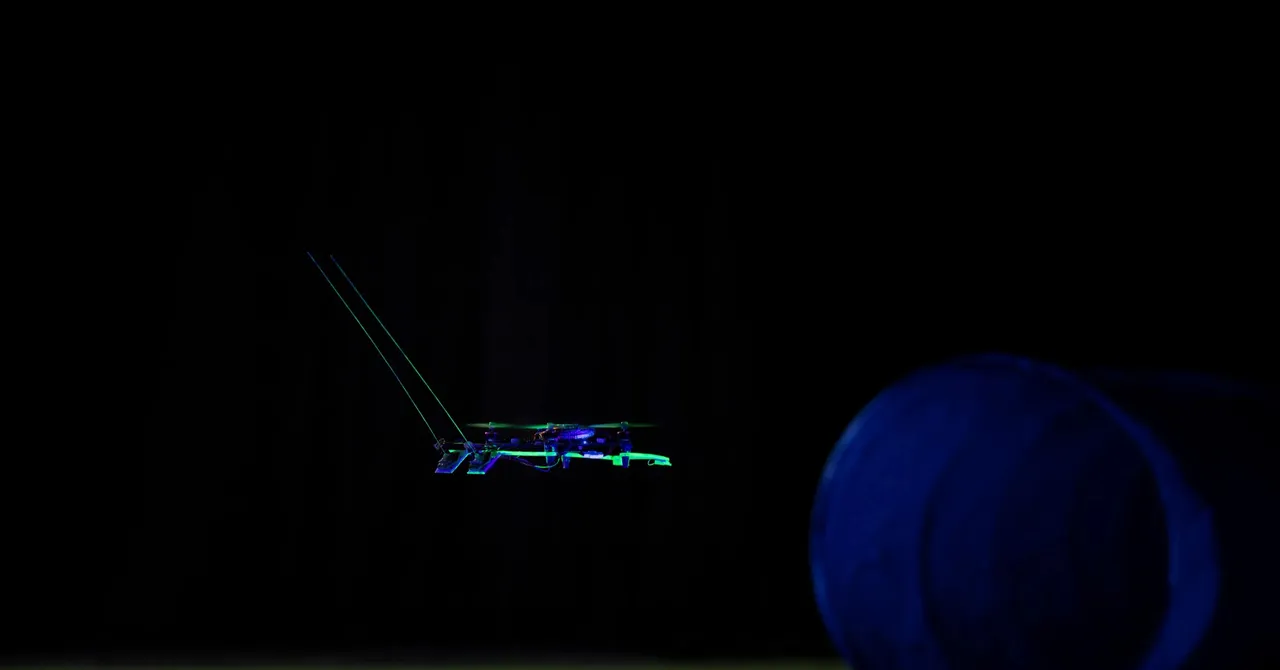

The “whiskers” Hamaza and her group crafted for the drone encompass delicate wires manufactured from nickel-titanium, every measuring 0.4 millimeters in diameter—concerning the thickness of 4 sheets of paper. The antennae, nonetheless, have been longer than the drone itself. To a palm-sized drone, the researchers hooked up two whiskers, every practically 8 inches lengthy with three small stress sensors on the base. These can assess the bending of the wires, from which the drone estimates its distance from and place in relation to close by limitations. All calculations mandatory for this navigation are processed by a microcontroller onboard the drone, with out counting on an external computer.
It could not sound too difficult, however even figuring out the angle at which to mount the wires was a problem. Animals that navigate by way of whisker generally do not fly. Having an extended protrusion, even when very gentle and delicate, could make the drone unstable. When transferring alongside a wall, the researchers noticed that resistance from the whisker may trigger the drone to rotate and crash.
The researchers in contrast a complete of 72 flights, testing six completely different angles at three completely different speeds. The drone flew with out main incident when the whiskers have been mounted at 30 levels, 45 levels, and 60 levels. Of those, the 45-degree angle was adopted as a result of it resulted within the least deviation within the drone’s orientation. Additionally they took under consideration the truth that a 60-degree angle reduces the ahead sensing vary.
The researchers additionally encountered a number of hurdles in processing the data taken in by the whiskers. One was distinguishing between precise contact alerts and disturbances attributable to the drone itself, akin to vibrations from the propellers. Even when filtering this noise out, about 38 p.c of the drone’s detections have been false positives.
The problem appeared to be drift, a phenomenon the place sensor readings steadily shift over time. The analysis group, due to this fact, developed a correction algorithm that repeatedly estimates the pattern of drifts over time—primarily based on sensor readings when the drone isn’t touching something—whereas in flight. When mixed with the filter, false positives reportedly dropped to 0 p.c.